AI Receptionist for Hospitals

From an unanswered ring to a confirmed slot in your HMS, and why answering is only half the job

Praveen Sahu
•
November 4, 2026
•
This is some text inside of a div block.
•
Every Call Gets Answered and the Slot Books Itself With an AI Receptionist for Hospitals

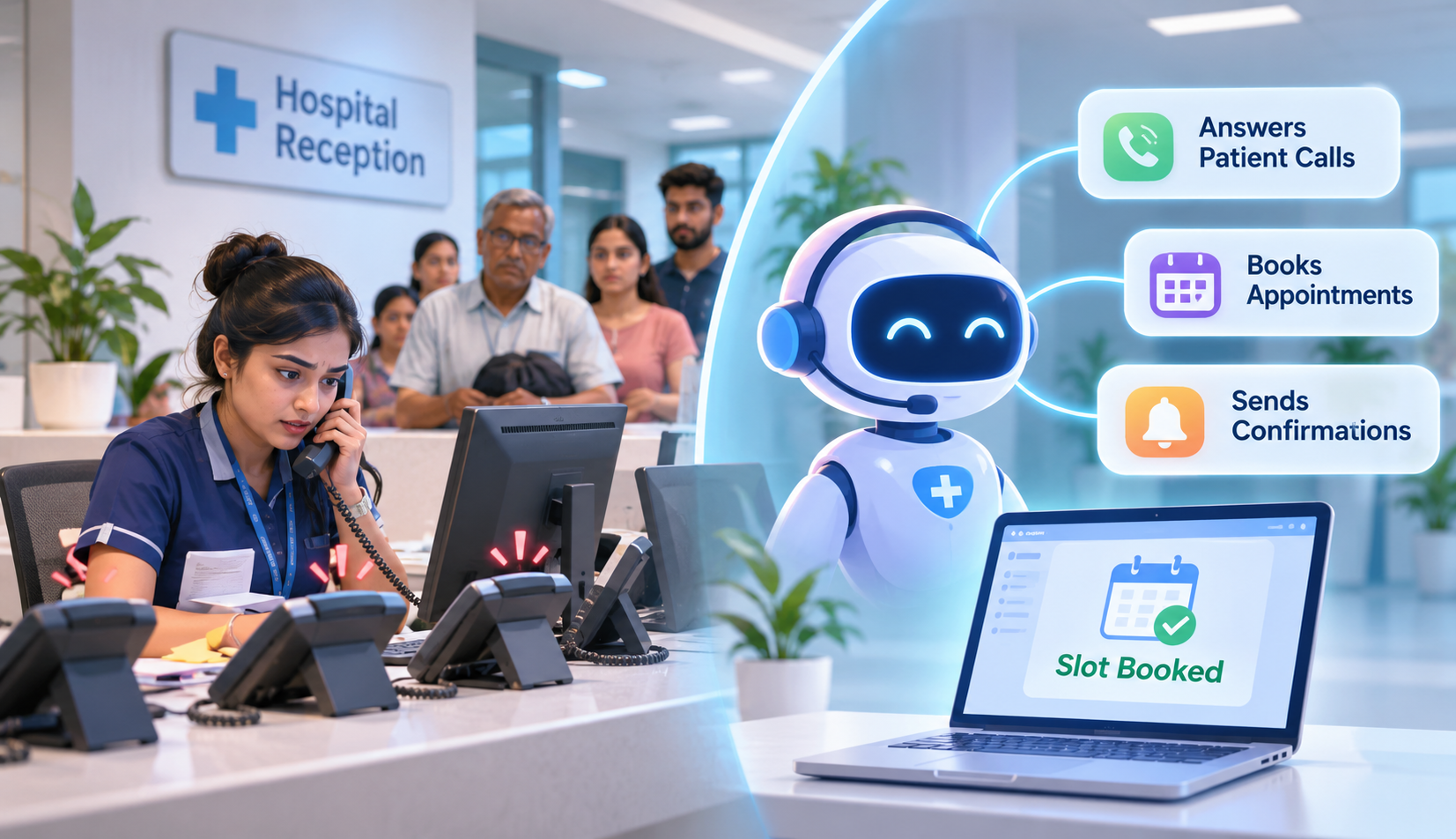
An AI receptionist for hospitals answers inbound patient calls, understands the request in natural speech, and books, reschedules or cancels the appointment directly in your hospital management system (HMS). It handles every call at once, including nights and Sundays. What it must never do is give clinical advice, so every call that needs judgement goes to a human.

That handover rule is what separates a safe deployment from a liability. We come back to it in Chapter 2.

‍

The timing matters in India. Patient call data falls under the Digital Personal Data Protection Act, 2023, and the DPDP Rules, 2025 notified in November 2025 put hospitals on a phased compliance timeline running to May 2027. Any voice deployment started now has to be built to that standard, not retrofitted later.

‍

In this post, we cover:

Chapter -1

What Does a Missed Call Actually Cost Your Hospital?

The leak never appears as a line item, which is why it runs for years

A missed call is not a lost phone call. It is a lost care pathway: the consult, and every diagnostic, procedure, pharmacy visit and follow-up attached to it. Most hospitals never see the number because there is no invoice for an appointment that did not happen.

‍

Where the Appointment Goes

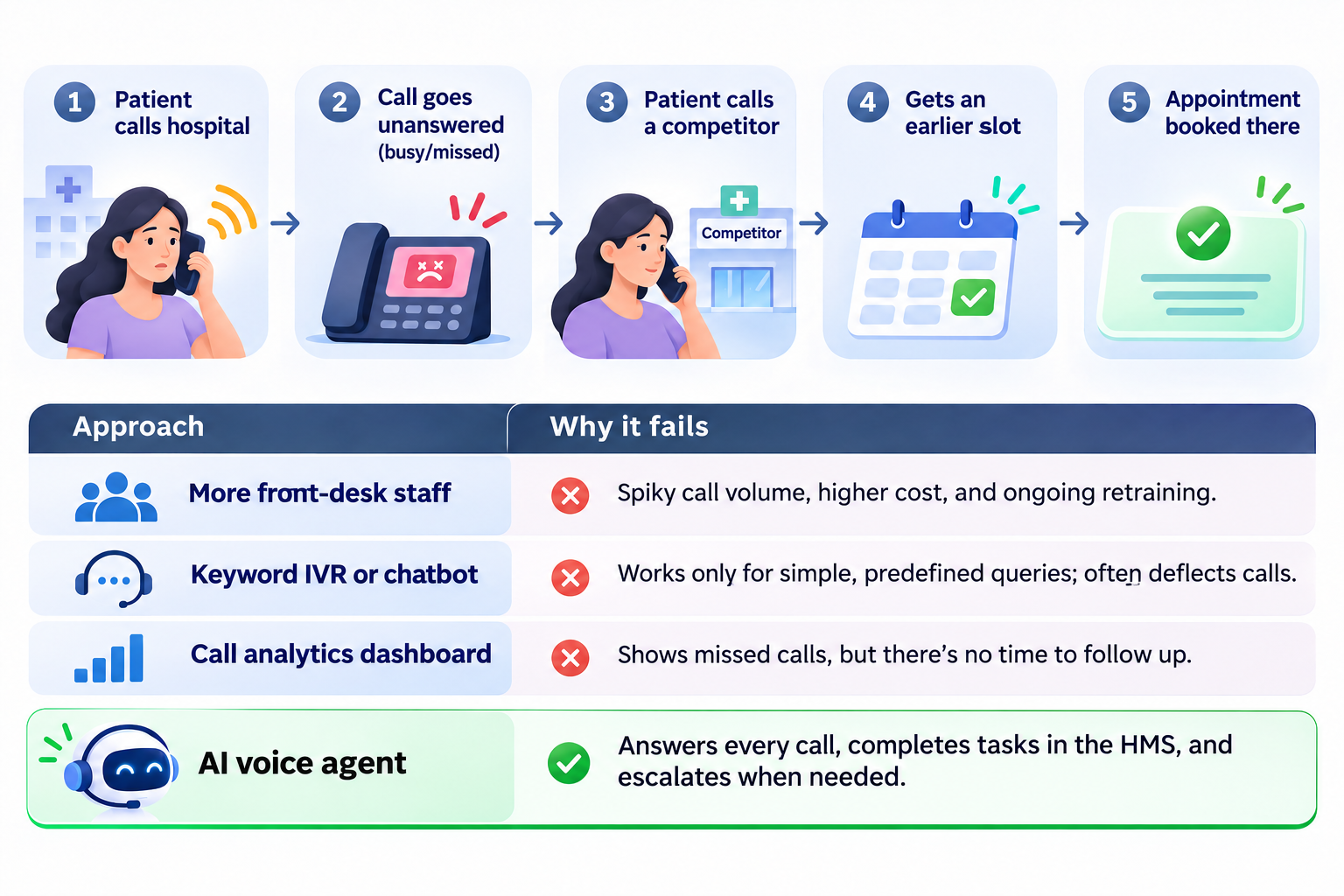
It is 9:40 on a Monday. The front desk has three lines ringing, a queue at registration, and a relative asking where radiology moved to. The fourth caller hears the phone ring out, hangs up, and dials the hospital two kilometres away. That caller wanted an orthopaedic consult. They now have one, somewhere else.

‍
Patients do not file a hospital they could not reach under "try again later". They file it under "unavailable". And the calls most likely to drop are the peak-hour, after-hours and Sunday calls, which are exactly when patients with real need are free to ring.

‍
The pattern shows up in booking data. A study of primary care self-scheduling published in [JMIR Medical Informatics](https://medinform.jmir.org/) found roughly 29.5% of booking activity happened outside regular business hours, when no reception team is on the phone at all.

‍

The Quieter Leak: Reschedules That Never Get Through

The second leak runs in the opposite direction. A patient who wants to cancel or move an appointment, and cannot get through, simply does not turn up. The slot sits empty, the doctor's time is wasted, and the person on the waitlist who would have taken it never hears about it.

‍
This one is worse than it looks, because you pay for it twice: once in the empty slot and once in the waitlist patient who goes elsewhere.

‍

Why More Staff, a Chatbot or a Dashboard Don't Fix It

Each is a reasonable first instinct, and each fails in a predictable way.

Approach Why it fails
More front-desk staff Call volume is spiky. Staff for the peak and you pay for idle time; staff for the average and you still drop calls exactly when they matter. Attrition means permanent retraining.
Keyword IVR or basic chatbot Handles the caller who already knows the department and says it the expected way. It deflects calls rather than resolving them.
Call analytics dashboard Tells you what you already suspected. Nobody calls the missed numbers back, because nobody has time — which was the original problem.
Recommended AI voice agent Answers every call in parallel, resolves the task in the HMS, and escalates what it should not handle.
CHapter_1_image
Chapter -2

What Does an AI Receptionist for Hospitals Actually Do?

The difference between a chatbot and an agent is that an agent finishes the task

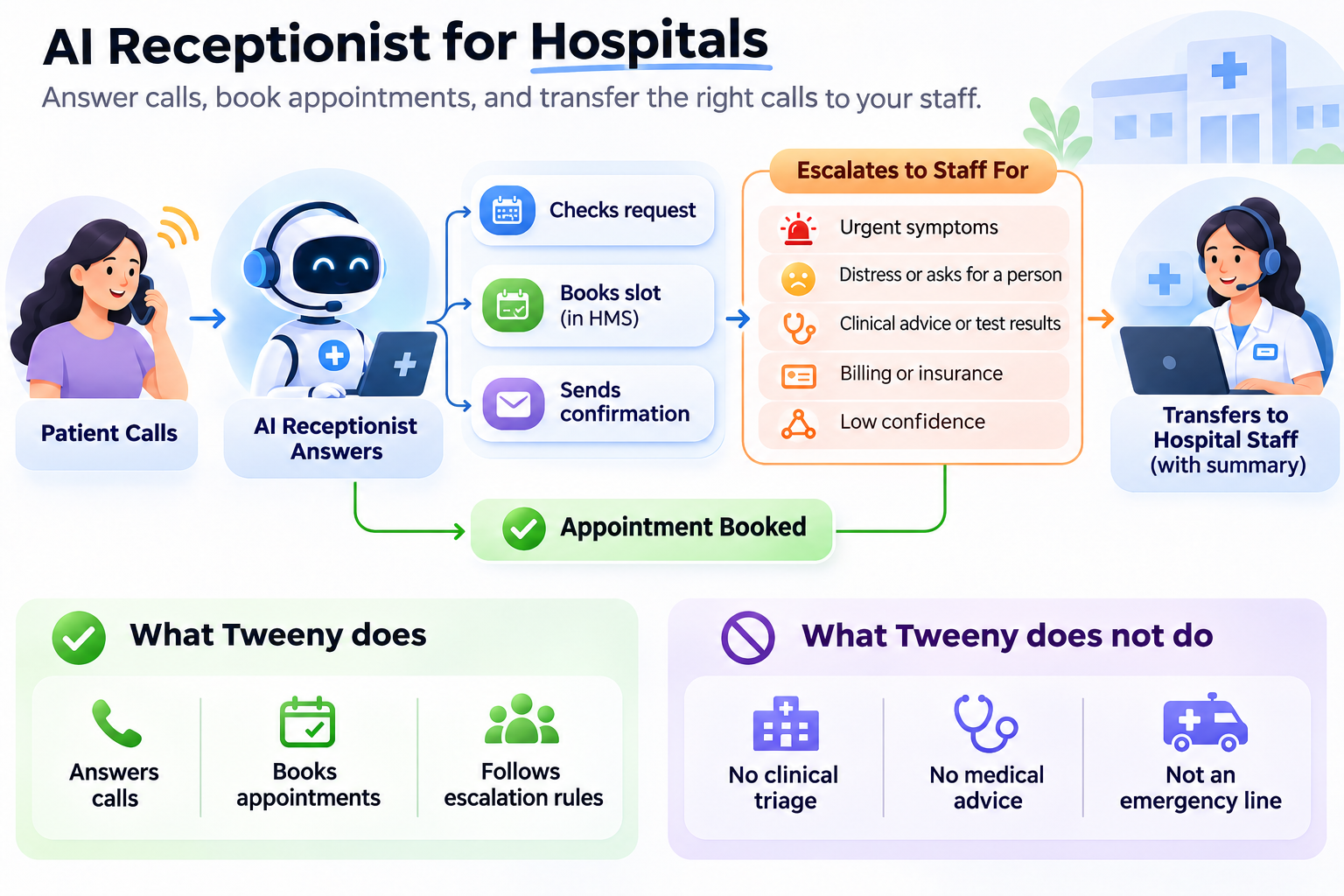
A chatbot answers. An agent books. The test of any hospital voice deployment is whether the patient hangs up with a confirmed appointment in your system, or with an instruction to call back during working hours.

‍

From Ring to Booked Appointment

The agent answers immediately, with no ring-out and no hold queue, and handles concurrent calls in parallel, so a Monday surge gets the same response as a quiet Wednesday. It works in the languages your patients actually call in, including code-mixed speech, with coverage scoped and tested per deployment rather than promised blanket.

‍
It identifies the caller against your existing records using phone number and a confirmation detail, or registers a new patient with the minimum fields your process requires. If the patient does not know which department they need, it asks about the reason for the visit. It never attempts a diagnosis.

‍

Acting Inside Your HMS

This is where most deployments either work or quietly fail. The agent reads live slot availability from your HIS or scheduling platform, books or modifies the appointment, and writes it back. It then confirms by SMS or WhatsApp with date, time, doctor, location and any preparation instructions.

‍

Every call produces a transcript, an outcome tag — booked, rescheduled, escalated, informational — and a booking-source marker in your system, so appointments can be attributed to the agent rather than guessed at.

‍

When It Must Hand Over to a Human

We design the escalation path first, not last. The agent transfers to a person, with a summary of the call so far, when the caller describes symptoms suggesting an emergency, when they are distressed or ask for a person, when the request involves clinical advice, test results, billing disputes or insurance pre-authorisation, or when its own confidence drops below a set threshold.

‍
What Tweeny does not do: we do not build clinical triage tools, we do not give medical advice through the agent, and we do not replace your emergency or ambulance line. We also do not sell an HMS. If the clinical documentation side is what you want covered, that is separate work — our AI Doctor Assistant drafts clinical notes and prescriptions inside your existing EMR.

Chapter_2_image
Chapter -3

How Do You Roll One Out and Measure It?

Start narrow, instrument first, and widen only when the numbers hold

An agent is only as reliable as the data and rules behind it. Get the schedules clean, start with after-hours calls where any answer beats a ring- out, and measure against a baseline you captured before go-live.

‍

What You Need in Place First

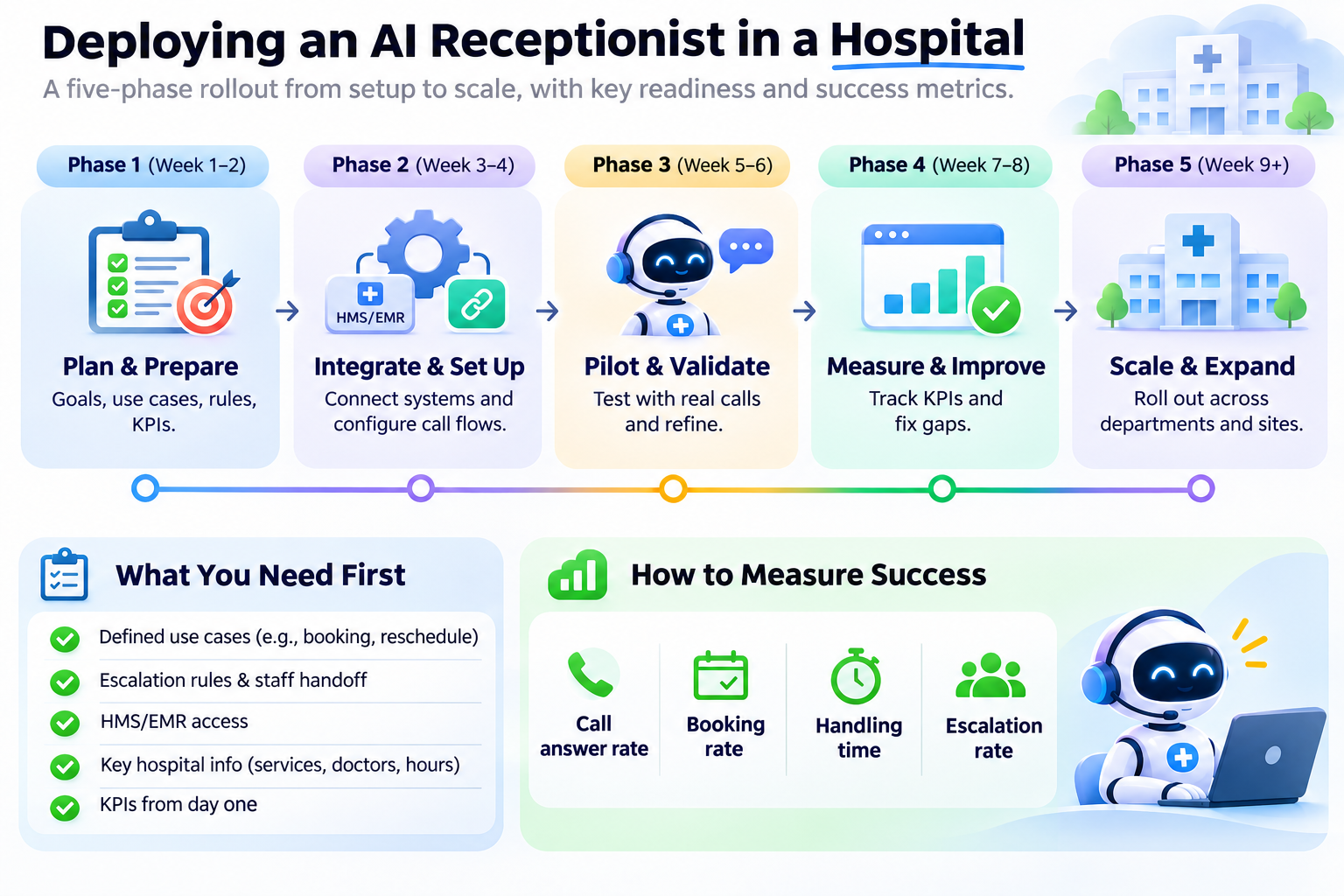
You need a current source of truth for doctor schedules, department mappings and slot rules, plus your FAQ content: timings, locations, documents, preparation instructions. If doctor schedules live in a WhatsApp group and a whiteboard, the agent will faithfully book into the wrong slots. Cleaning that up is often the most valuable part of the project, agent or not.

‍
Technically, the minimum is read and write access to scheduling, read access to patient identity, a telephony connection, and a messaging channel for confirmations. On compliance, the DPDP framework shapes consent capture at the start of each call, what is recorded and for how long, where it is processed, and who can read transcripts. We document the data flows so your DPO can audit them.

‍

Where to Start

Run it in this order, and widen only on evidence:

  • After-hours and overflow calls, where any answer beats a ring-out
  • One or two high-volume departments during working hours
  • Rescheduling and cancellation handling, with waitlist backfill
  • Outbound reminders and follow-up calls
  • Remaining departments

Before go-live, the agent is scored against a test set built from your real call patterns: common requests, awkward phrasings, accents, background noise, and edge cases like a caller booking for a family member. Escalation recall matters more than containment — missing a call that needed a human is the only failure that is not recoverable.

‍

What to Measure

Instrument these from day one, against a pre-deployment baseline:

  • Answer rate and abandonment rate, from telephony logs
  • Call-to-booking conversion, by the agent-tagged booking source in your HMS
  • After-hours bookings, which were previously zero by definition
  • Escalation accuracy, from a weekly human review of a call sample
  • Slot backfill: cancelled slots refilled from the waitlist
  • No-show trend, once reminder calls are live
  • Front-desk load: whether staff time is moving from the phone to the counter

Without the baseline you will have a list of numbers and no story.

Chapter_3_image
FINAL THOUGHT

A hospital is not judged on the calls it answers. It is judged on the one it didn't.

Every patient who calls with intent to book should either get booked or reach a human who can help. That is the whole standard, and it is measurable.

‍

Start with your after-hours calls for four weeks and compare against your current numbers. When you are ready to scope it, [talk to a healthcare AI team about connecting a voice agent to your HMS] (https://www.tweeny.ai/services).

‍

‍

‍

Bring AI-Powered Patient Access Into Your HMS

Explore how Tweeny builds AI-powered healthcare solutions that answer every patient call, book directly into existing hospital systems and give your front desk back to the patients standing in front of them.

Contact

Frequently Asked Questions

Common questions about AI receptionists, patient call handling and HMS integration

Can an AI receptionist for hospitals stop missed calls from losing appointments?

Faq Plus

Will the AI receptionist give medical advice or triage patients?

Faq Plus

Does it work with our existing hospital information system?

Faq Plus

How is patient data protected under Indian law?

Faq Plus

Does this replace our front-desk staff?

Faq Plus

Explore more blogs