Three stories: the forgotten recall list, the Tamil-speaking patient and the 11 pm booking.
Scheduling agents pay off first in three places. They bring back patients who are overdue (recall and reactivation). They talk to patients in their own language (multilingual support). And they book appointments at night and on weekends (after-hours booking). Each one turns the demand you already have into visits on the calendar.
Story 1: Patient recall and reactivation
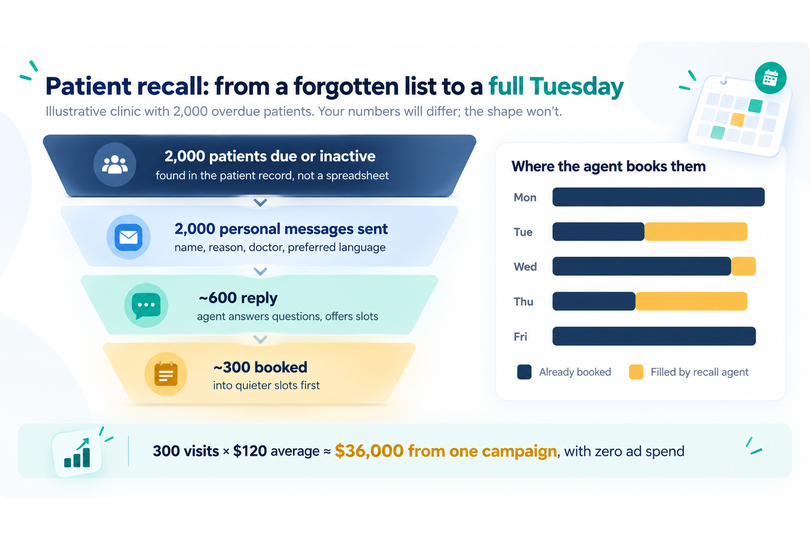
The moment: Picture a six-doctor clinic. Its records show 2,000 patients who are overdue: diabetes reviews, annual check-ups, refills that ran out months ago. Everyone agrees someone should call them. Nobody has the time, so the list sits there.
What the agent does: It works the list in a weekend. It finds every patient who is due or has gone quiet. Each one gets a personal message with their name, their doctor and the reason for the visit, in their preferred language. When a patient replies, the agent answers questions and offers slots, starting with the quieter days of the week.
Here is the math, using illustrative numbers. If 30% of those 2,000 patients reply and half of them book, that is 300 visits. At a $120 average visit value, one campaign brings in about $36,000, with zero ad spend. Run it every quarter, and it becomes a steady revenue line.
This is already happening at scale. Fierce Healthcare reported in May 2026 that Annapolis Internal Medicine booked 61% of its flu-shot appointments through AI-led outreach.
Story 2: Multilingual patient support
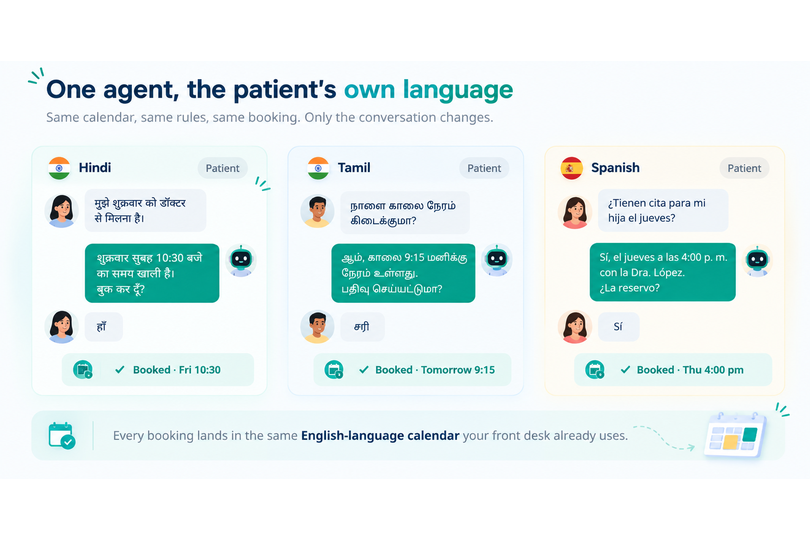
The moment: A retired schoolteacher in Chennai needs a follow-up with her cardiologist. She is comfortable in Tamil, not English. Twice she called, got confused by the phone menu, and hung up. Her daughter eventually booked for her, a week late.
What the agent does: Now she types her question in Tamil. The agent replies in Tamil, offers a 9:15 slot tomorrow, and books it. The appointment lands in the same English-language calendar the front desk already uses. The same agent can speak Hindi, Spanish or other languages your patients prefer.
The gap is real and measurable. In a secret-shopper study published in JAMA and reported by TechTarget Patient Engagement, 61% of calls from English speakers led to a scheduled cancer appointment. Only 36% of Spanish-speaking callers and 19% of Mandarin-speaking callers got the same result. Online is not much better: a 2025 University of Michigan study found 29% of US hospitals offer no patient portal login in any language other than English. The MGMA also advises sending reminders in the patient's preferred language to cut no-shows.
Story 3: After-hours appointment booking
The moment: A father notices a rash on his son's arm at 11 pm. It is not an emergency, but he wants the child seen tomorrow. The clinic line goes to voicemail. By morning, he has booked with a competitor that had an online slot.
What the agent does: With an agent on the line, he gets an answer at 11 pm. The agent asks a few scripted questions and books the first morning slot. If he mentions warning signs such as trouble breathing, the agent follows the clinic's triage protocol: it directs him to emergency care and alerts the on-call team.
Patients want this. In the same Salesforce survey covered by Fierce Healthcare, 67% said they would rather use 24/7 AI help than wait for office hours. And 44% said round-the-clock AI help would make them more likely to stay with their provider.